




Key Takeaways:
- It is time-consuming to manually validate vendor data, and it’s error-prone.
- Patchwork ERP systems cause data silos and inconsistencies.
- Validation ensures that the data is valid, accurate, and in compliance.
- Intelligent automation solutions have a lot of ERPs that can be associated with them.
- It reduces the risk by automating the vendor data validation process and increases efficiency.
The insurance business, historically dependent on manual processes, is being increasingly challenged to improve efficiency, reduce costs, and improve customer experience. Settling claims is the most time- and resource-consuming business of the insurance industry. All this is set to change with Large Language Models (LLMs) and Robotic Process Automation (RPA). What we are presenting in this article is an argument on how LLM and RPA can transform and accelerate the process of settling the insurance claims for the benefit of both the insurer and the policyholder.
Also read: Vendor Scorecarding with Multi-Agent Data Aggregation
The Issue: Data Silos and Manual Headaches
Several companies have several ERP systems, each of which carries supplier data for one purpose. One outcome of this spread-out process is the data silos, which in turn generate errors and gaps in your database. Consider a multinational company with several ERP departments in various locations. Principal changes on one system cannot be replicated on another, or a supplier can be added with minor differing information on separate systems. For cross-verification data, tracing differences, and correction, the conventional method of master validation supplier often needs human involvement. Apart from requiring a lot of time and materials, this is also very prone to errors.
Common problematic areas are:
- Duplicate Vendor Files: Inefficiencies and errors can arise when the same vendor is entered repeatedly with minor changes.
- Old Data: Not all systems perform regular updates of contact data, bank details, or vendor addresses that have changed.
- Compliance Risks: Inaccurate information could result in non-compliance with regulations, with fines and legal penalties.
- Fraud Risks: The payments to unauthorized accounts constitute only one example of fraudulent use of unvalidated data.
- Operational Delays: Payments, supply chain transactions, and procurement activities can all be delayed due to erroneous vendor information.
These risks demonstrate the true and pressing need for an enhanced and automated vendor master data validation solution.
The Solution
Vendor master data validation automated across ERPs is an innovative solution to these problems. By using intelligent workflows and advanced technology, organizations are able to ensure that their data is compliant, consistent, and accurate in real time. The solution depends on having a centralized validation engine that connects to all the ERPs present.
This engine can perform a range of validation tests, which include:
- Data Format Validation: Verifying that data fields match predefined formats, like valid emails and correct tax-ID format.
- Completeness checks: Verifying all required fields are filled.
- Duplicate finding: Identifying duplicate vendor records in all synchronized systems.
- Consistency checks between systems: Comparing vendor data from multiple ERPs and marking any inconsistencies.
- Third-Party Data Integration: Validating vendor data against outside databases to make it even more accurate (e.g., validating creditworthiness and sanctions data).
- Workflow-Driven Approvals: Passing differences highlighted to the right people for verification and authorization, making sure people are held accountable when necessary.
The implementation of such an automated process shifts the paradigm from reactive error fixing to proactive management of data.
Auxiliobits’ Approach: Intelligent Automation for Vendor Data
We know how to deal with vendor master data across different ERP environments at Auxiliobits. We create our intelligent automation solutions with a motive to make the entire validation process faster and more effective so that the data becomes accurate and the business can go ahead without any issues. We use a combination of Robotic Process Automation (RPA), Artificial Intelligence (AI), and Machine Learning (ML) to create a complete solution to validate vendor data.
Our approach includes:
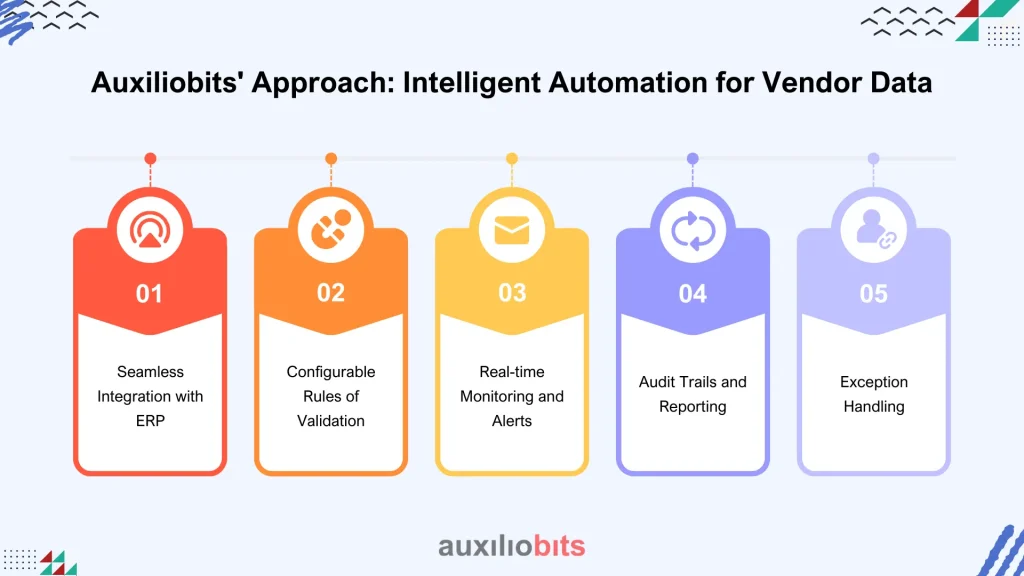
- Seamless Integration with ERP: For the sole purpose of providing an integrated perspective of vendor information, our solutions are carefully crafted to integrate impeccably with various ERP systems such as SAP, Oracle, Microsoft Dynamics, and others.
- Configurable Rules of Validation: We facilitate businesses in creating custom validation rules that are especially designed to cater to their unique compliance requirements and business processes.
- Real-time Monitoring and Alerts: Our system is constantly monitoring vendor data and alerting users in real-time to any deviations or inconsistencies.
- Audit Trails and Reporting: Detailed audit trails and thorough reports provide visibility into the validation process, promoting internal controls and compliance.
- Exception Handling: To minimize operation disruption, advanced exception handling procedures direct problem data for human inspection and resolution.
This solid ground allows businesses to maintain clean, accurate, and up-to-date vendor master data, lowering risk and enhancing decision-making.
Case Study: Streamlining Vendor Onboarding for a Global Manufacturer
Human Data Entry: A multinational manufacturing global firm was facing difficulties with Vendor Onboarding from manual data entry and validation procedures on several regional ERP systems, resulting in enormous processing time and human errors. Work around bottlenecks. Inefficient and slow procurement created friction with suppliers; it was not unusual for the team to spend weeks onboarding vendors.
Auxiliobits integrated the company’s SAP and Oracle ERPs with a web-based automated vendor master data verification service. This feature is facilitated automatically by the solution:
- Early data capture and verification: New vendor requests were automatically verified against the external database and pre-loaded rules.
- Duplicate check: Any possible duplicate vendor record within both ERPs was detected and marked by the system.
- Cross-system synchronization: In order to maintain consistency, seller data was synchronized across all relevant ERPs after automatic approval.
- Exception for workflow processing: Any inconsistency in information was routed to a particular team for early processing and disposal.
Results
- Vendor onboarding time savings: The Average time spent onboarding vendors was cut down from weeks to a couple of days.
- Enhanced data accuracy: As a result of a steep drop in the rate of data errors and discrepancies, there were no longer low payment problems and compliance risk.
- Enhanced operating effectiveness: With heavily reduced manual effort, the procurement personnel were able to focus on major projects.
- Enhanced supplier relationship: Correct payment and faster onboarding enhanced the relationship with strategic suppliers.
This case study illustrates the real gains from automating vendor master data validation and how this can increase supply chain resilience and operating efficiency.
Conclusion
Validation of vendor master data across ERPs in modern business should not be a luxury but automated. It can enable improved operations, safer security, and smarter decisions by removing the issues of isolated data, human mistakes, and compliance risk. Smart automation can cause businesses to reduce their expenses, stabilize the vendor ecosystem, and gain huge efficiencies. To unlock the potential of automation and to upgrade your vendor management process today by ensuring bad vendor data will not keep your enterprise frameworks in chains.
Ready to revolutionize your vendor master data management? Contact Auxiliobits today to learn how our intelligent automation solutions can transform your business. Explore our services here for more insights on how we can help you achieve operational excellence.